Z Ray Tracer
About
Z Ray Tracer (ZRT) is a physically based general-purpose ray tracer developed by Hongzhi Wu as an effort to learn the theories and practices of physically based rendering. Z stands for "zhui", a Chinese character which means "trace". Currently I am using it as a test-bed for rendering research (by writing plugins for it).
Features
| Architecture: | Multi-threading, Flexible C-like script language*, Highly customizable Plugins, Instances, Variuous debugging options (partial rendering, debugging shader, etc) |
| Geometry: | Basic Primitives, .OBJ meshes with materials, kd-tree based intersection routines |
| Textures: | Popular texture formats, Mipmap construction, HDR, Environment maps, Normal maps |
| Shadering Models: | Lambertian, Ward, Cook-Torrance, Measured BRDF(MERL Database) |
| Rendering Techniques: | Path tracing, Photon-mapping, Multiple Importance Sampling, Quasi Monte-Carlo |
Screenshots
Please click on the thumbnails to see the original pictures.
|
|
 |
 |
 |
 |
|
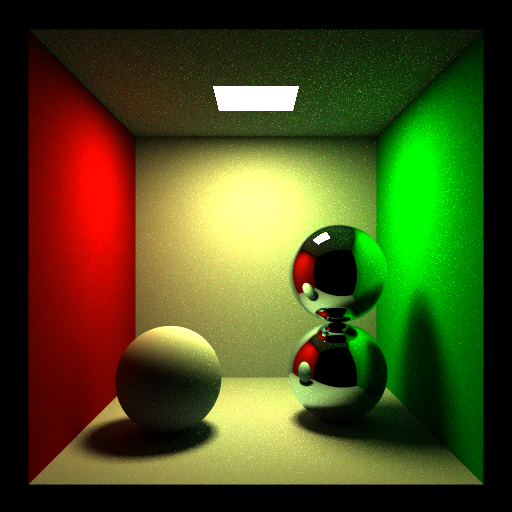
Two mirror
balls perfect mirror and global diffuse illumination shader, area light, 4 shadow rays, mirror reflectance = 0.9. |
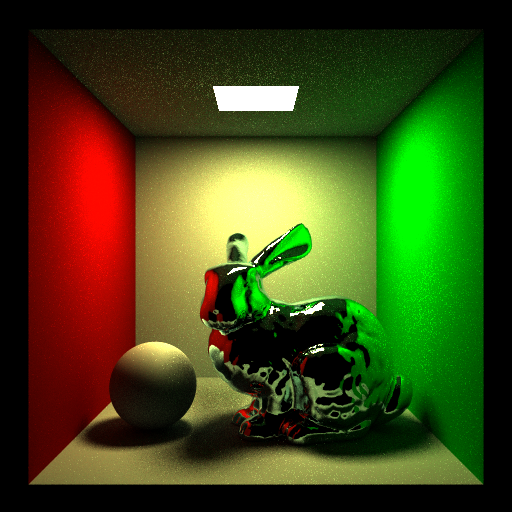
Mirror bunny
and diffuse ball perfect mirror and global diffuse illumination shader, area light, 4 shadow rays, mirror reflectance = 0.9. |
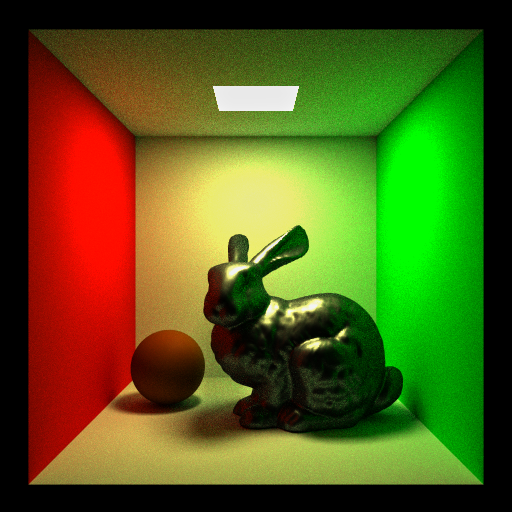
Silver bunny
and orange ball measured isotropic BRDF global illumination shader, 4 shadow rays, BRDFs[2]: silver-metallic-paint, orange-paint |
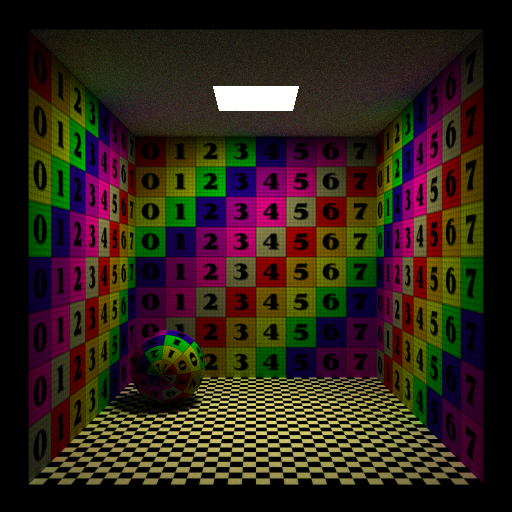
Textured scene global diffuse illumination shader, 4 shadow rays |
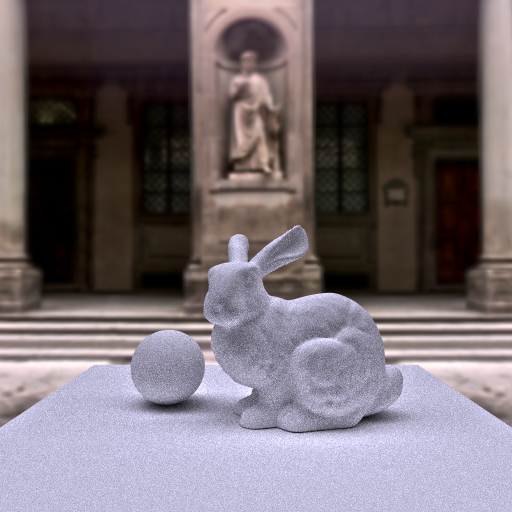
Diffuse scene
in a lightprobe global diffuse illumination shader, uffizi light probe, 64 shadow rays |
 |
 |
 |
 |
 |
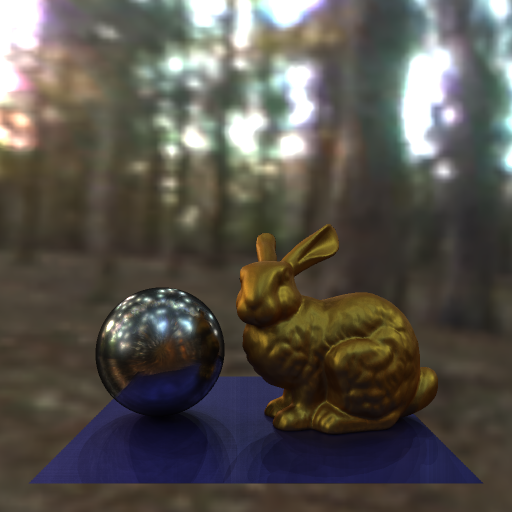
| Bronze bunny and a silver ball on a plane with blue- metallic-paint BRDF |
Tainted screws
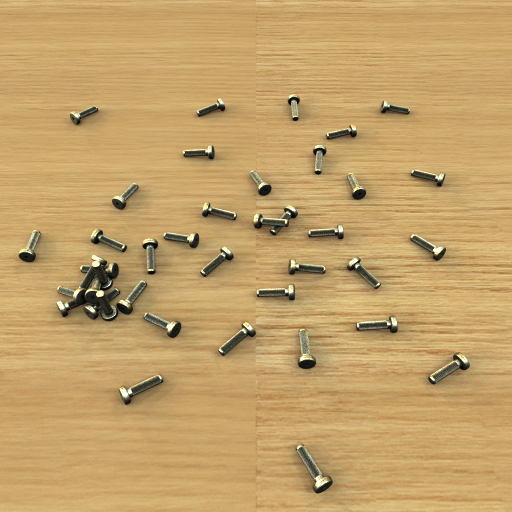
on a table screws using measured silver-metallic-paint BRDF modulated with a texture. Note the anisotropicity on the body of the screws due to the small-scale varaitions in geometry |
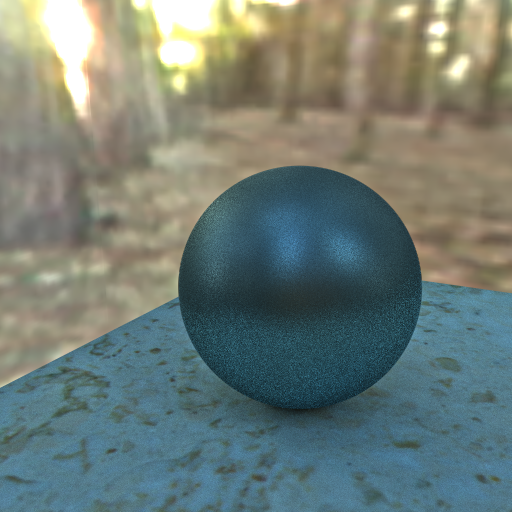
Silver-metallic-paint ball measured isotropic BRDF global illumination shader, 64 shadow rays |
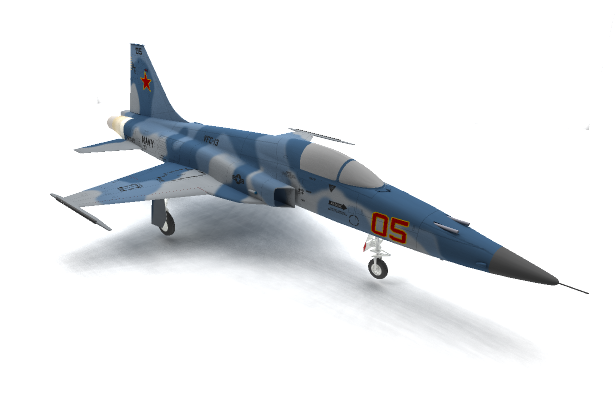
Fighter global diffuse illumination shader |
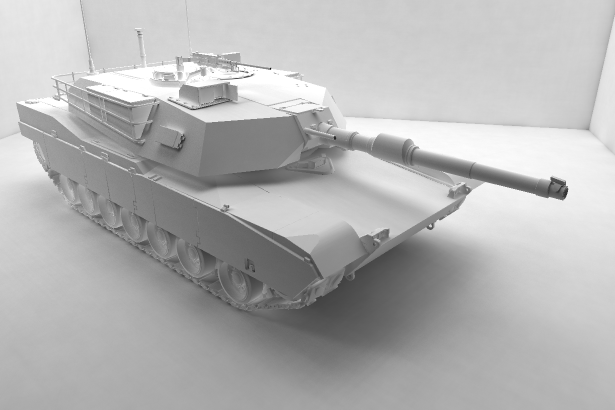
Tank global diffuse illumination shader |
R&D Log
07/13/2007 Implemented tone mapping using bilateral filtering [3]. Some of the pictures below are adjusted using tone-mapping.
05/06/2007 Used flex and bison to generate a parser for our own scene description. Now ZRT is a completely data-driven command line tool.
04/29/2007 Added 2d MIP-MAPed textures and cube map.
04/24/2007 Added isotropic BRDF shaders for both analytical(Ward) and measured-data (MERL dataset) models.
04/03/2007 Added support for triangular meshes; Added a BSP tree based intersection accelerator for meshes and a kd tree acceleration structure for the entire scene.
03/27/2007 Summary of previous progress: Established the overall general purpose offline renderer architecture. Features area light, soft shadows, indirect lighting (global illumination) shader and perfect mirror shader.
Sample Scene Configuration File
|
cam = pinhole_camera(vector3(0, 1, 3.25), vector3(0, 1, -3), vector3(0, 1, 0), 0.1, 0.1, 0.1)
cam_sampler = super_camera_sampler(cam, subpixel = 2, 0)
// init light lt_scale = 0.5lt = env_light( spectrum(lt_scale, lt_scale, lt_scale), 100000, raw_RGB_cube_texture("Data\rnl_cross.raw_cube"),transformation( ) ) // init shaders sh = global_diffuse_shader() matr_white = material ( "diffuse_reflectance" = RGB(0.9, 0.9, 0.9) ) matr_red = material ( "diffuse_reflectance" = RGB(0.9, 0.1, 0.1) ) matr_green = material ( "diffuse_reflectance" = RGB(0.1, 0.9, 0.1) ) linkmap = shader_link_map ( "reflectance" = "diffuse_reflectance", "reflectance_mapping" = "mapping", "reflectance_texture" = "texture", "reflectance_sampler" = "sampler" ) rect = rectangle_shape(2.0, 2.0) sphere= sphere_shape(0.25) plane = kd_tri_mesh_shape("Data\airplane.obj", 0.01, 6)
//bottom obj_bottom = simple_object(rect,transformation( rotate_x(-PI/2), translate(0.0, 0.0, 0.0) ), matr_white, sh, linkmap)
//back obj_back = simple_object(rect,transformation( translate(0.0, 1.0, -1.0) ), matr_white, sh, linkmap)
//left obj_left = simple_object(rect,transformation( rotate_y(PI/2), translate(-1.0, 1.0, 0.0) ), matr_red, sh, linkmap)
//ball1 obj_ball = simple_object(sphere,transformation( translate(-0.65, 0.25, 0.4) ), matr_white, sh, linkmap) //plane obj_plane = simple_object(plane, transformation( scale(0.8, 0.8, 0.8), rotate_x(-PI/2), rotate_y(-PI/6), translate(-0.1, 0.6, -0.05) ), matr_white, sh, linkmap) // init scene s = photon_mapped_scene(num_photons = 1000000, 0, kd_scene_isaccelerator(0.01, 4)) s += (lt, obj_back, obj_bottom, obj_left, obj_plane, obj_ball)
// let's get started... imaging(s, cam_sampler,width = 256, height = 256, photon_mapping_option(256, num_shadow = 512, //shadow rays num_gather = 256, //gather rays num_lookup = 8000, radius = 0.025, gather = 1, // gather for L_i or use photon estimation directly trace = 1 // direct raytrace L_d or use photon estimation directly ), "boxenvp.raw" ) shell("raw2png boxenvp.raw /o boxenvp.png") |
References
[1] Matt Pharr and Greg Humphreys. Physically based rendering. Morgan Kaufmann Press, 2004
[2] Wojciech Matusik, Hanspeter Pfister, Matt Brand, and Leonard McMillan. A data-driven reflectance model. ACM Trans. Graph. 22(3):759-769, 2003
[3] Fredo Durand and Julie Dorsey. Fast Bilateral Filtering for the Display of High-Dynamic-Range Images. Proceedings of the 29th annual conference on Computer graphics and interactive techniques : 257-266, 2002
Last Updated 2018-12-10 18:51:13